Enchanted by Tanigawa-dake’s Ichinokurasawa—The Beauty of the Divine Rock Walls Dwelling in the Mountain of Deat
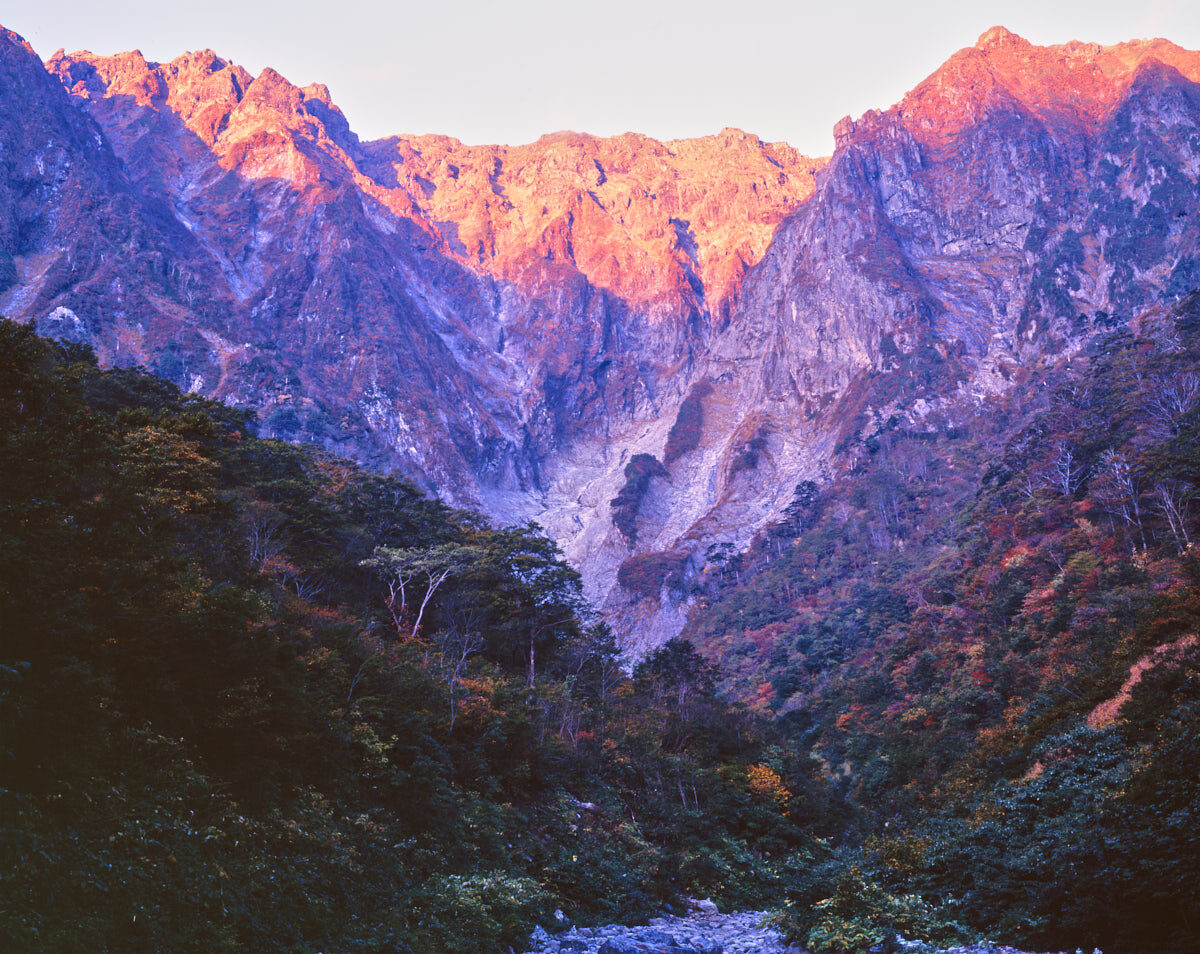
Mt. Tanigawa’s Ichinokurasawa – an imposing rock face feared as the “Mountain of Death” yet captivating to many. I look back on the days spent pursuing its morning scenery, enveloped in divine majesty and silence, with a large-format camera.
Tanigawa-dake Ichinokurasawa, known as the Mountain of Death
Over 800 victims, a source of both fear and fascination
Tanigawa-dake’s Ichinokurasawa is known as the “Mountain of Death.” Since ancient times, countless climbers have been drawn to its overwhelming cliffs and have continually challenged them. However, due to its extreme difficulty, many climbers have lost their lives. Since 1931, the total number of fatalities from accidents on Tanigawa-dake is said to exceed 800, with the majority occurring at Ichinokurasawa.
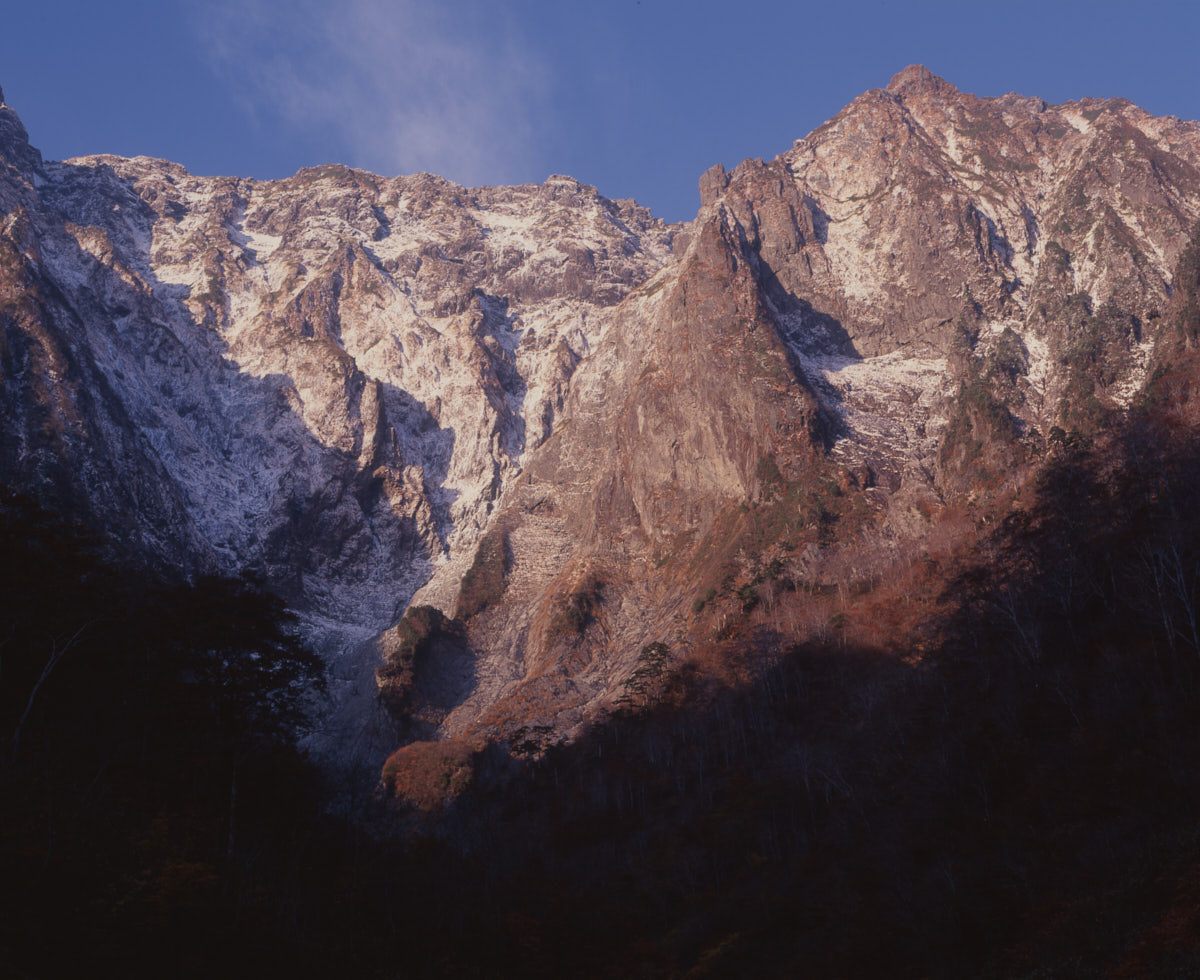
Among them, the sheer cliff known as Shōtoku Rock rises vertically to a height of approximately 400 meters. Its overwhelming presence is often compared to El Capitan in Yosemite National Park, USA. Its form transcends mere awe, evoking a sense of the divine.
The shock of seeing Ichinokurasawa for the first time
The divine majesty emanating from nature’s overwhelmingly magnificent forms
I am neither a mountaineer nor do I have any rock climbing experience. Yet when I first laid eyes on this place, I couldn’t help but gasp. The awe I felt then rivaled the first time I saw Mount Hotaka in Kamikochi. The massive rock wall seemed like a work of art crafted by nature itself, beckoning me from a distance that felt close enough to reach out and touch.
Of course, I lacked the strength to climb it myself and could only quietly gaze upon its form, yet there were still ample reasons to be drawn to it. Its accessibility is another major appeal. Unlike the Northern Alps, there’s no lengthy approach; you can reach it in just about 20 minutes from the Minakami Interchange on the Kan-Etsu Expressway.
Capturing the texture of rock surfaces with a large-format camera
Horseman 4×5: Challenging the Silent Morning
At the time, I lived in Muikamachi, Niigata Prefecture, and it took about an hour by car from my home to Ichinokurasawa. If I left at 4 a.m., I could arrive at the location by 5:30 a.m. Even after finishing my photography, I could be back home by 8:30 a.m. and still make it to work. On clear days, I went there almost like it was a daily routine.
My trusty camera is a Horseman 4×5. I loaded a Gitzo tripod into the backseat of my car and brought along about ten rolls of film I’d loaded the day before for the shoot. Back then, you could drive your own car right up to the base of Ichinokurazawa, so transporting the gear wasn’t too much of a hassle.
Arriving at the site before dawn, I found several photographers already set up with their tripods. I joined them, waiting for the moment the morning sun would break through. With large-format cameras, photographers don dark hoods, peering through a ground glass screen with a magnifying glass to focus. That scene, too, was filled with a quiet tension.
The rock’s appearance changes with the angle of light
Ichinokurazawa has only a few viewpoints, so compositions tend to be similar. However, the expression of the rock surface subtly changes each time depending on how the light hits it. Especially the texture of the Shōtoku Rock reveals complex and delicate patterns that only a large-format camera can capture. Unfortunately, JPEG images on the web cannot fully reproduce that intricacy, but the sheer power and presence of the rock surface seen on-site remains strongly etched in my memory.
The cliffs of Maehodaka are impressive, but Ichinokurasawa offers an even more visceral sense of the rocks closing in. The stillness before sunrise, and the moment the sun breaks through, making the rock face glow red. In that instant, coldness and the pulse of life coexist—that is the essence of this place.
The image of Ichinokurasawa that remains in my heart even now
Ichinokurazawa, known as the “Mountain of Death.” Yet beyond that name lies a place of mystery and beauty, possessing an irresistible power that draws people in.
Now that I live in Toyama, I can’t go there every morning like I used to, but someday I hope to see the moment when the morning sun shines on those majestic rock walls again.

Medical Doctor・Amateur Photographer
Photography and audio are my hobbies. While landscape photography is my main focus, I have recently started taking many photos of my pets at home.